تأثير البعد الثقافي لـ Hofstede (الفردية مقابل الجماعية) في الإفصاح المحاسبي: دراسة مقارنة لدولٍ مُختارة
الشريط الجانبي للمقالة
THIS IS AN OPEN ACCESS ARTICLE UNDER THE CC BY LICENSE
محتوى المقالة الرئيسي

الملخص
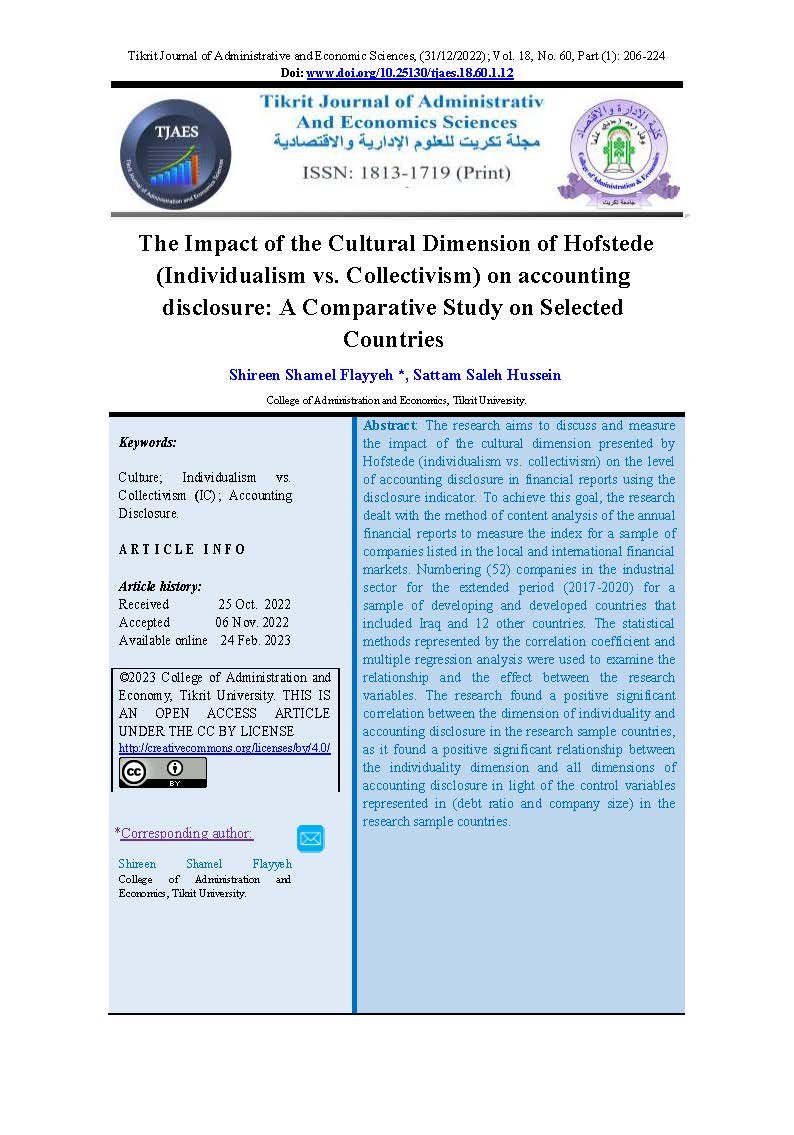
يهدف البحث إلى مناقشة وقياس تأثير البُعد الثقافي المقدم من Hofstede (الفردية مقابل الجماعية) في مستوى الإفصاح المحاسبي في التقارير المالية باستخدام مؤشر الافصاح، ولتحقيق هذا الهدف فقد تناول البحث أسلوب تحليل المحتوى للتقارير المالية السنوية لقياس المؤشر لعينة من الشركات المدرجة في الأسواق المالية المحلية والعالمية والبالغ عددها (52) شركة في القطاع الصناعي للفترة الممتدة (2017-2020) لعينة من الدول النامية والمتقدمة شملت العراق و12 دولة أخرى، وقد تم استخدام الأساليب الإحصائية المتمثلة (بمعامل الارتباط وتحليل الانحدار المتعدد) في فحص العلاقة والتأثير بين متغيري البحث، وتوصل البحث إلى وجود علاقة ارتباط معنوية إيجابية بين بُعد الفردية والافصاح المحاسبي في الدول عينة البحث، إذ توصل إلى وجود علاقة معنوية إيجابية بين بعُد الفردية وجميع أبعاد الإفصاح المحاسبي في ظل المتغيرات الحاكمة المتمثلة في (نسبة المديونية وحجم الشركة) في الدول عينة البحث.
التنزيلات
تفاصيل المقالة
المراجع
أولاً. المصادر العربية:
أ. الرسائل الجامعية:
كرجي، محمد باقر، (2017)، قياس مستوى الإفصاح المحاسبي في التقارير المالية على وفق المعايير المحاسبية الدولية والقواعد المحلية وأثره على قرارات الاستثمار "دراسة تطبيقية في عينة من الشركات المساهمة المدرجة في سوق العراق لأوراق المالية"، رسالة ماجستير في المحاسبة، كلية الإدارة والاقتصاد، جامعة القادسية، جمهورية العراق.
ب. الدوريات العلمية:
الججاوي، طلال، يعقوب، ابتهاج، (2017)، التحفظ المحاسبي في الممارسات المحاسبية من منظور الأبعاد الثقافية لـ (Hofstede) وبالإشارة إلى البعد السادس (IVR) (بحث استكشافي في سوق العراق للأوراق المالية)، المجلة العراقية للعلوم الادارية، المجلد 13، العدد 52، كلية الإدارة والاقتصاد، جامعة كربلاء، جمهورية العراق.
شريف، ناصر طالب، جاسم، سنان رحيم، (2019)، مدى الإفصاح في التقارير المالية لتطبيق المعيار المحاسبي الدولي رقم (1) للشركات الصناعية الأردنية (قطاع الصناعات الغذائية والمشروبات)، مجلة جامعة الأنبار للعلوم الاقتصادية والإدارية، المجلد 11، العدد 26، كلية الإدارة والاقتصاد، جامعة الانبار، جمهورية العراق.
تولي، سعاد السيد محمد، (2021)، دراسة أثر الإفصاح الاختياري على الأداء المالي للشركات في ظل تبني معايير التقارير المالية الدولية IFRS (دراسة اختبارية على الشركات المقيدة في البورصة المصرية)، مجلة البحوث المالية والتجارية، المجلد 22، العدد2، كلية التجارة، جامعة بور سعيد، جمهورية مصر العربية.
محمد، شاجوان ماجد، أحمد، وريا برهان، (2020)، انعكاسات القيم لـ Hofstede في تطبيقات الأبعاد المحاسبية لحوكمة الشركات" دراسة ميدانية لواقع الشركات المساهمة في بيئة إقليم كردستان العراق"، مجلة قلاي زانست العلمية، المجلد 5، العدد 1، الجامعة اللبنانية الفرنسية – أربيل، كوردستان العراق.
الكتب
-الشيرازي، عباس مهدي، (1990)، نظرية المحاسبة، الطبعة الأولى، ذات السلاسل للطباعة والنشر والتوزيع، الكويت.
ثانياً. المصادر الأجنبية:
A. Thesis:
Crocamo, F., (2015), The impact of the national culture on the ethical standards of the German restaurant market, Thesis, Saimaa University of Applied Sciences.
Young, M., (2013), Cultural Influences on Accounting and Its Practices, Thesis, Liberty University.
B. Periodicals:
Ahmed, Mashal & Shafiq, Saima, (2014), The Impact of Organizational Culture on Organizational Performance: A Case Study of Telecom Sector, Global Journal of Management and Business Research, Vol.14, Iss.3.
Akman, H. Nazlı, (2011), The Effect of IFRS Adoption on Financial Disclosure: Does Culture Still Play A Role? American International Journal of Contemporary Research, Vol. 1, No.1.
Askary, S. & Yazdifar, H. & Askarany, D., (2008), Culture and accounting practices in Turkey, International Journal of Accounting, Auditing and Performance Evaluation, Vol. 5, No.1.
Borker, David, (2013), Accounting and Cultural Values: IFRS In 3G Economies, International Business & Economics Research Journal, Vol. 12, No. 6.
Borker, David, (2013), Is There A Favorable Cultural Profile For IFRS?: An Examination And Extension Of Gray's Accounting Value Hypotheses, International Business & Economics Research Journal, Vol. 12, No. 2.
Borker, David, (2014), IFRS and Socio-cultural Orientation in Egypt, Iran and Iraq, Journal of Accounting and Finance, Vol. 14, No.5.
Dou, P. & Truong, C. & Veeraraghavan, M., (2016), Individualism, Uncertainty Avoidance, and Earnings Momentum in International Markets, Contemporary Accounting Research, Vol. 33, No. 2.
Doupnik, T. & Riccio, E., (2006), The influence of conservatism and secrecy on the interpretation of verbal probability expressions in the Anglo and Latin cultural areas, The International Journal of Accounting, Vol. 41, No. 3.
Elsaid, Eahab & Elsaid, Abdel Moneim, (2012), Culture and leadership: Comparing Egypt to the GLOBE study of 62 societies, Business and Management Research, Vol. 1, No. 2.
Gallén, María L. & Peraita, Carlos, (2018), The effects of national culture on corporate social responsibility disclosure: a cross-country comparison, Applied Economics, Vol. 50, No. 27.
Haniffa, R. & Cooke, T., (2005), The impact of culture and governance on corporate social reporting, Journal of accounting and public policy, Vol. 24, No. 5.
Heidhues, E. & Patel, C., (2011), A critique of Gray’s framework on accounting values using Germany as a case study, Critical Perspectives on Accounting, Vol. 22, No. 3.
Khlif, Hichem, (2016), Hofstede’s cultural dimensions in accounting research: a review, Meditari Accountancy Research, Vol. 24, Iss. 4.
Perera, Hector, (1989), Accounting in developing countries: a case for localised uniformity, British Accounting Review, Vol. 21.
Polat, Haci, (2019), Impact of Cultural Dimensions to Individualism, and Collectivism Dimension, Journal of Business and Economics, Vol.10, No. 12.
1Salter, S. & Lewis, P., (2011), Shades of Gray: An empirical examination of Gray's model of culture and income measurement practices using 20-F data, Advances in Accounting, incorporating Advances in International Accounting, Vol. 27, No. 1.
Salter, S. & Niswander, F., (1995), Cultural Influence on The Development of Accounting Systems Internationally: A Test of Gray's [1988] Theory, Journal of International Business Studies, Vol. 26, No.2.
Stulza, R. & Williamson, R., (2003), Culture, openness, and finance, Journal of financial Economics, Vol. 70, No. 3.
Vollero, A. & Siano, A. & Palazzo, M. & Amabile, S., (2019), Hoftsede's cultural dimensions and corporate social responsibility in online communication: Are they independent constructs? Corporate Social Responsibility and Environmental Management.
Zarzeski, T. Marilyn, (1996), Spontaneous harmonization effects of culture and market forces on accounting disclosure practices, accounting horizons, Vol. 10, No. 1.
C. Books
Choi, F., Meek, G., (2011), “International Accounting”, 7th Ed., Prentice Hall.
Hofstede, G. (2011), Dimensionalizing Cultures: The Hofstede Model in Context. Online Readings in Psychology and Culture, Unit 2. Retrieved from http://scholarworks.gvsu.edu/orpc/vol2/iss1/8.
Hofstede, G., Hofstede, G., & Minkov, M., (2010), Cultures and organizations: software of the mind”, 3rd Ed., McGraw Hill, New York.
D. Other
www.hofstede-insights.com Hofstedeمركز موقع